
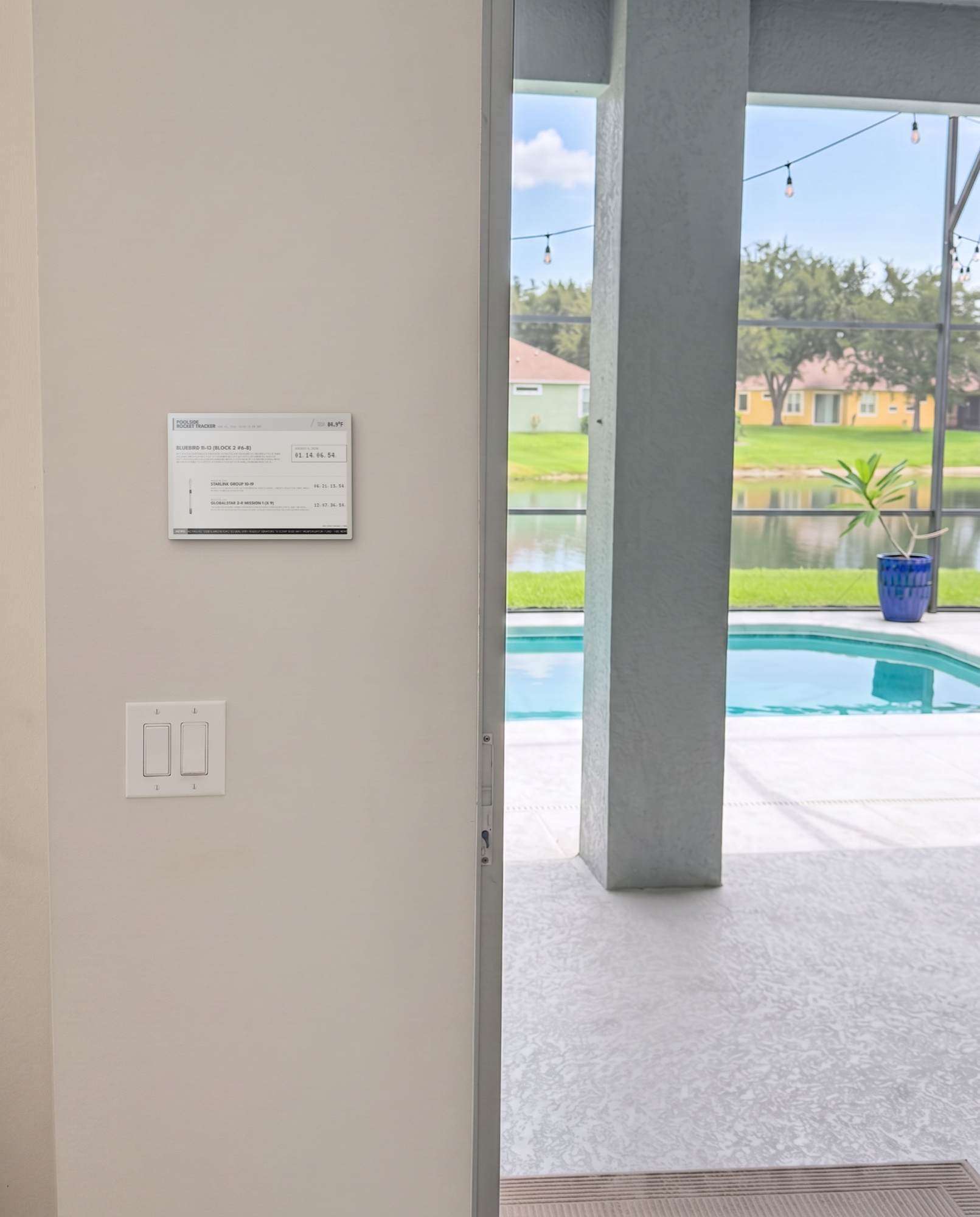
Central Florida has a strange privilege: when something lifts off from Kennedy Space Center or Cape Canaveral, you can walk outside and watch it climb. The hard part isn’t seeing it. The hard part is knowing it’s about to happen.
That’s the whole problem this solves. A small panel by the pool door showing the next three launches off the Cape with live countdowns — so you glance at the wall on the way out and know whether tonight is worth staying up for. No app, no notification, no phone in a wet hand.
What’s on the board
The lead launch gets the room: mission name, date, the description straight from the launch feed, and a countdown ticking in days, hours, minutes and seconds. Two more sit below it. A line drawing of the actual vehicle stands alongside — Falcon 9, Falcon Heavy, Atlas V, Vulcan, New Glenn or SLS, whichever is flying next.
Across the top: the date, a live clock, and the pool temperature pulled from the sensor in the water. Along the bottom, a news ticker of current space stories scrolling at a fixed reading pace.
How it stays current
Three feeds — launches, news, and the pool sensor — relayed through our own server so the browser only ever talks to one origin. Countdowns tick locally every second, so the numbers move between refreshes rather than sitting still. Launch and news data refresh about every sixteen minutes, the pool reading every six. Each cadence sits just outside its relay’s cache window, so a refresh returns something new instead of the same answer twice.
The details that took the longest
The ticker. The first version scrolled the whole strip and left a full screen of dead black before the headlines came back around. It now renders the feed twice and scrolls exactly one copy-width, so the last headline chains straight into the first. A small white rocket marks the seam. Speed is fixed in pixels per second and the loop duration is calculated from the measured width of the day’s headlines — so a wordy news day reads at the same pace as a quiet one.
It updates itself. The panel checks a small build-stamp file every ten minutes and reloads only when that stamp changes. Push a fix and the display picks it up on its own, without anyone walking over with a keyboard. Every check where nothing has changed is ignored, so it never reloads mid-glance for no reason.
It answers a touch. Tap any launch and a card opens with the full mission description, the vehicle, the pad, the launch site, and its own live countdown. Leave it alone for a minute and it returns to the board by itself — a display nobody is tending shouldn’t stay stuck on something somebody opened yesterday.
The hardware
A 10-inch panel, 1920 × 1200, in a 3D-printed white frame a quarter-inch wide, mounted a quarter-inch proud of the wall so it reads as an object rather than a screen sunk into drywall. It sits eight inches above the light switch by the pool door, centred on that section of wall.
The software runs today; the panel is next. Its resolution is taller than the layout’s current kiosk breakpoint expects, so the board needs an explicit kiosk mode rather than one inferred from window height. That’s the next honest piece of work, and it’s why this still says prototype.